

Adriatic maritime tourism facing a new investment cycle!
Adriatic ports are experiencing a steady recovery and growth in traffic this year, but the region continues to face infrastructural and regulatory challenges. This slows it down compared to the rest of Mediterranean. According to the latest Adriatic Sea Tourism Report, presented by the consultancy firm Risposte Turismo Adriatic Sea Forum in Venice, Cruises, ferry traffic, and nautical tourism are recording positive trends. These trends are driven by a strong investment cycle.
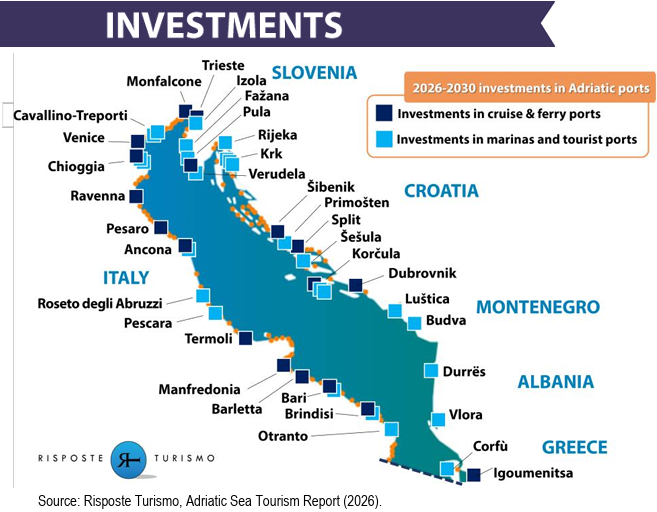
Namely, over €843 million is planned to be invested in port and maritime infrastructure on the Adriatic between 2027 and 2030. This clearly shows the direction in which the region is developing.
Cruises are returning, but the traffic structure is changing
Forecasts for 2026 predict around 5.7 million cruise passengers, a 6% increase on the previous year. Although the number of arrivals is set to reach a record 4,000, the total number of passengers still lags behind the historic figures of 2019. Interestingly, the Adriatic is the only region in the Mediterranean to record a drop in traffic compared to the pre-pandemic period. This is mainly due to local regulations and the inability to accommodate megaships. Consequently, smaller and medium-sized vessels now dominate the traffic mix, while homeports are losing their share.
Italy holds a leading position with over 2.1 million cruise guests, while Croatia firmly holds second place with an expected 1.61 million passengers. On the port rankings, Corfu is leading, breaking the one million passenger mark for the first time. It is followed by Dubrovnik with 675,000 and Kotor with 615,000 visitors.
The journey is stable, Split remains on the throne
Scheduled coastal and international ferry, hydrofoil and catamaran services continue to grow moderately. It is expected that by the end of the year 20.6 million passengers will pass through Adriatic ports, an increase of 2.1 per cent.
In this sector, the Croatian ports hold the primacy. Split remains the uncrowned leader of the Adriatic with more than 5.2 million passengers, while Zadar is in third place with 2.7 million. Greek Igoumenitsa is positioned between them.
Expansion of charters and optimism in the charter market
The nautical sector is showing exceptional resilience and steady growth in supply. Currently, 347 marinas and tourist ports are mapped on the Adriatic, offering a total of 81,710 berths. As many as 93 per cent of these capacities are located in Italy and Croatia.
Operators in the nautical charter segment (particularly in the sailing and motor yacht segments) are reporting significantly better expectations and more stable demand compared to previous years. This confirms that the market, after a turbulent period, has entered a phase of mature consolidation.
Read the full report Here


