


A week's holiday is unavailable to 27.5 percent of Europeans
New Eurostat data show a significant gap in travel availability within the European Union. The problem is particularly pronounced in Southeastern and Central Europe, where four countries have the highest proportion of citizens who cannot afford a week's holiday.
Growth in tourism doesn't necessarily mean increased travel accessibility.
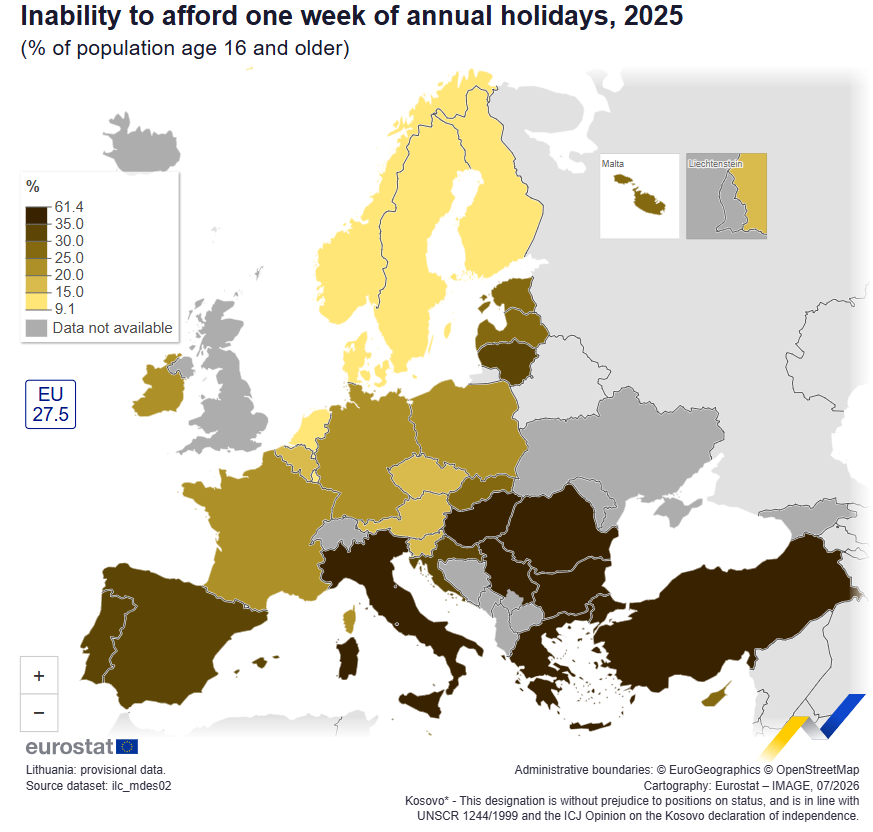
In 2025, 27.5 per cent of the European Union's population aged 16 and over did not have enough money for a week's holiday away from home. The share increased by 0.5 percentage points compared to the previous year.
However, long-term progress has been recorded. Ten years ago, the proportion of citizens without the financial means for such a holiday was higher by 7.7 percentage points.
The indicator does not only cover overseas travel. It refers to the ability to finance a week away from home, and therefore includes domestic travel as well.
Romania, Greece, Bulgaria and Hungary at the top
The regional context is particularly important. The largest share was recorded in Romania, where 61.4 percent of the population cannot afford a week's holiday. This is followed by Greece with 46.6 percent.
In Bulgaria and Hungary, this share amounts to 39.1 percent. All four countries are significantly above the EU average, showing that the financial accessibility of travel remains a major challenge in this part of Europe.
Slovenia and Croatia are not among the countries with the highest shares in Eurostat's publication. However, the data is important for the tourism sector in both countries because a large part of their outbound demand comes precisely from Central and South-Eastern Europe.
At the other end of the scale are Luxembourg with 10.6 percent, Sweden with 12.4 percent and the Netherlands with 12.8 percent.
What does data mean for regional tourism
For agencies, hotels and carriers in the region, this is a clear signal that rising prices may limit domestic demand. Family holidays, longer stays and peak season travel could be particularly affected.
At the same time, there is growing scope for shorter arrangements, instalment payments, off-peak travel, and products with clearly controlled total costs. This is particularly important for Croatia, where high seasonal prices can further distance the offer from guests from neighbouring countries.
European tourism It continues to record strong traffic, but the data confirms that the number of arrivals is not the only measure of market health. For a large part of the region's population, an annual holiday remains a matter of disposable income, and not just a desire to travel.


