



Croatian hospitality industry needs €5.2 billion in investment: most hotels are entering a phase of obsolescence
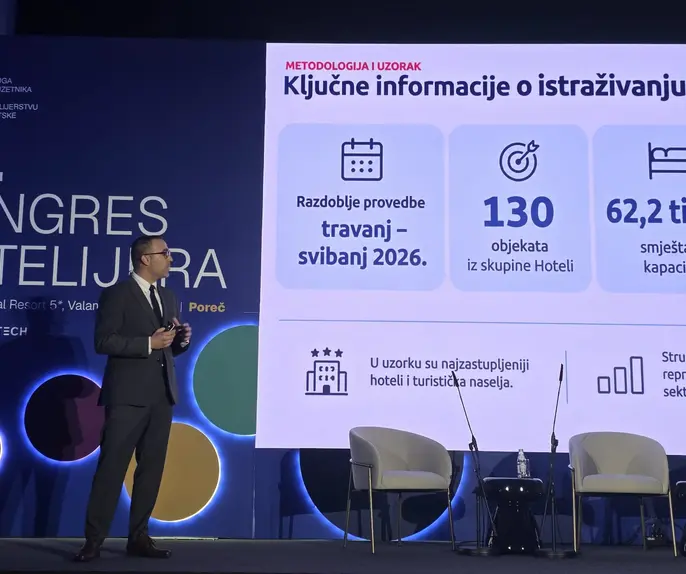
Croatian hospitality is entering a period in which it is no longer enough to rely on a good season and strong demand. The message from the 28th Hoteliers' Congress, held at the Pical Resort in Porec, is that without a serious investment cycle it will not be possible to maintain competitiveness or raise the quality of the domestic hotel offering to the level demanded by today's market.
Figures defining the state of the sector
According to analysis by HUT and UPUHH, Croatian hotels are on average 55 years old, and it has been an average of 12 years since their last major renovation. It is further concerning that 18 per cent of hotels had their last significant renovation more than 20 years ago.
The problem is particularly pronounced among three-star hotels, where as many as 91 per cent of establishments are in the maturity or decline phase. In other words, part of the domestic supply no longer meets market expectations, neither in terms of accommodation quality, nor in terms of facilities, nor in terms of the overall experience.
The largest part of the investment goes towards renovation and modernisation.
The total investment needs of the Croatian hotel industry over the next five years are estimated at €5.2 billion. The largest share of this sum relates to the renovation of existing hotels, which clearly shows that the sector must first address the issue of outdated capacity.
Most hotels, 78.2 per cent, plan to maintain their current category, while 21.8 per cent intend to raise their quality level, mainly towards four- and five-star categories. This means that investments will not be directed solely at essential construction works, but also at increasing the market value of the product.
Twenty-three new hotels have been announced, but that is not enough.
According to a survey of tourism companies, 23 new hotels are planned for construction over the next five years. Of these, 17 are to be four-star and six five-star. This is an important signal that investment interest exists, but also a figure that shows the gap between needs and concrete plans remains large.
6 five-star hotels
The industry assessment goes far beyond the projects currently announced. According to the views expressed at the congress, Croatia will need between 80,000 and 100,000 new hotel beds over the next ten years to improve the structure of its accommodation capacity.
This is particularly important because hotel accommodation accounts for only 9.2 per cent of total capacity, which is significantly less than in competing Mediterranean countries. It is precisely in this disparity that one of the key structural problems of domestic tourism can be seen.
The currently planned projects are an important start, but on their own they cannot significantly change the overall structure of accommodation.
Why there are no more new greenfield projects
Hoteliers at the congress highlighted several reasons why the development of new hotels remains slow. Among the main obstacles they cited are high land prices, a sluggish local administration, legal uncertainty, construction costs and business models that do not provide an attractive enough return on investment.
Therefore, the sector is increasingly calling for a more stable and predictable investment environment, as well as new development models, including mixed-use resorts. Such projects combine a hotel product with other commercial or tourist facilities to make the investment more sustainable and financially attractive.
More quality hotels also means more traffic in the off-season.
A greater number of quality hotels would have an impact not only on the accommodation structure, but also on seasonality. According to estimates presented at the congress, the implementation of the planned new hotels would increase the share of off-season nights from 17.5 to 20.2 per cent, and would generate around 2.96 million additional nights outside the main summer months.
However, hotel investments alone will not be sufficient if they are not accompanied by the development of additional facilities in the destinations. For more successful year-round operations, transport connectivity, events, conference infrastructure, wellness, gastronomy and other reasons to visit outside the summer months are equally important.
Investments in hotels also have a broader fiscal impact.
The planned investments would not only benefit hotel companies and destinations. According to estimates presented at the congress, the €5.2 billion investment cycle would generate €493 million in one-off fiscal revenues, while additional annual fiscal and parafiscal levies following the investment would amount to €431 million.
Competitiveness can no longer be built without investment and technology.
The congress also warned of the wider problem of the competitiveness of Croatian tourism. An analysis by Horwath HTL has shown that Croatia is lagging behind some of its regional competitors in investment, air connectivity and the attraction of foreign guests. If this trend is to be reversed, hotels must be regarded as strategic infrastructure rather than merely as individual private investments.
At the same time, investments no longer just mean construction work and upgrading the hotel's category. Guests are looking for quality, flexibility, safety and a seamless digital experience, and the trend for last-minute bookings is becoming increasingly pronounced. Therefore, a hotel's future competitiveness also depends on digitalisation, sales channels, revenue management, and its presence on the platforms where travellers research and choose accommodation, including tools based on artificial intelligence.
Award-winning hotel leaders
At the 28th Congress of Hoteliers, awards for the best managers of Croatian hotels were traditionally presented. The UPUHH's expert jury presented the awards in partnership with the international school of hospitality and tourism Les Roches.
- Dražen Mofardin – Director of the 5-star Pical Resort, Valamar Collection, for excellence in hotel opening
- Lovorka Struna – Boutique Hotel Alhambra & Historic Villas, Best Small Hotel Manager (up to 50 rooms)
- Denis Terlević – Valamar Amicor Resort, Best Manager of a 3- and 4-star hotel with more than 50 rooms
- Marko Bačić – Grand Park Hotel Rovinj, Best Manager of a Large Hotel with 5 Stars and More Than 50 Rooms
- Vlado Lučić – special recognition for a lifetime's work and long-standing contribution to Croatian hospitality
The congress's conclusion is not dramatic, but it is very clear: Croatian hospitality still has room for growth, but without a new investment cycle that potential will remain untapped. The refurbishment of existing hotels, the development of new capacity and the creation of more stable investment conditions are becoming matters of long-term sustainability and competitiveness for the entire tourism sector.


